- Introduction
- 1. What DataClassification Is (From a Developer Perspective)
- 2. Why It Exists in SaaS
- 3. Classification Types — Business Meaning
- 4. What It Impacts — and What It Does Not
- 5. Important Telemetry Nuance (For Technical Consultants)
- 6. From AL to the Client: The Data Classification Worksheet
- 7. DataClassification vs Data Sensitivity (Common Confusion)
- 8. Shared Responsibility Model
- 9. Common Consultant Mistakes
- 10. Metadata Is Architecture
- Conclusion
Introduction
Many partners treat DataClassification as a property added just to stop AppSourceCop from complaining.
In SaaS, that mindset is incomplete.
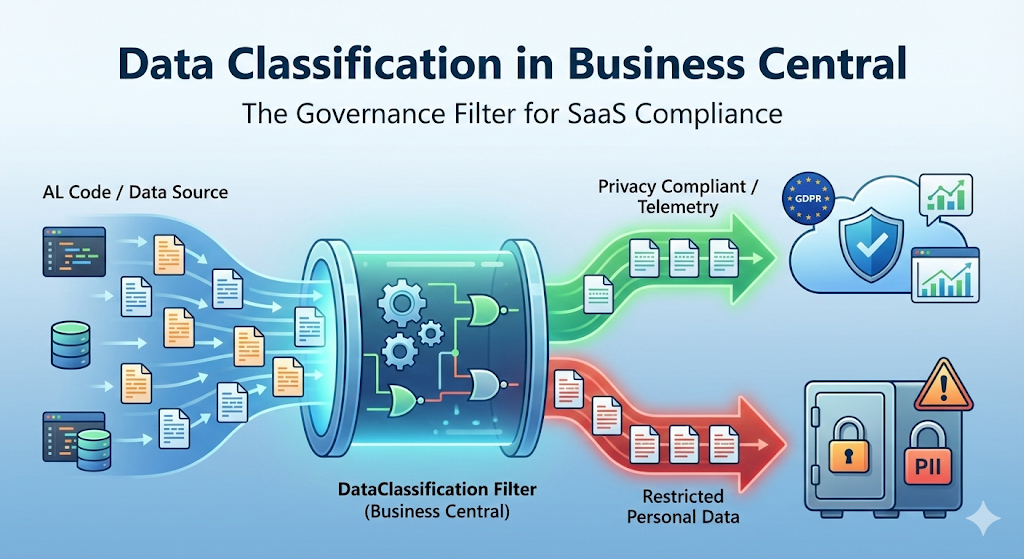
In Business Central online, DataClassification is not just a development property — it is a compliance signal that connects:
- AL development
- Privacy tooling
- Telemetry safeguards
- Tenant governance processes
Microsoft requires that fields of class Normal must have a DataClassification value and must not remain ToBeClassified (enforced by AppSourceCop rule AS0016 and part of technical validation).
But the reason goes beyond validation.
In a regulated, cloud-first environment, metadata influences behavior.
This article explains:
- What
DataClassificationactually does - How it connects to the Business Central client
- How it impacts privacy tooling and telemetry
- The difference between developer classification and customer sensitivity
- The governance responsibilities across roles
1. What DataClassification Is (From a Developer Perspective)
DataClassification is an AL property defined on table fields.
Example:
field(50101; "Personal Email"; Text[100])
{
    DataClassification = EndUserIdentifiableInformation;
}
For fields of class Normal:
- The property is mandatory.
- The value must not remain
ToBeClassified.
It defines the intended nature of the data stored in that field.
However, it does not:
- Control permissions
- Encrypt data
- Mask fields
- Override security roles
It is not a security feature.
It is metadata used for privacy and compliance mechanisms.
2. Why It Exists in SaaS
In on-prem deployments, customers manage compliance largely on their own.
In SaaS:
- Microsoft operates the infrastructure.
- Privacy regulations (GDPR and others) apply globally.
- Customers expect export and privacy tooling to work accurately.
- Telemetry must not leak personal data.
To support this, the platform must understand what kind of data fields contain.
DataClassification provides that signal.
Without accurate classification, privacy tooling cannot reliably identify which fields contain personal or sensitive information.
In SaaS, metadata drives compliance processes.
3. Classification Types — Business Meaning
CustomerContent
Operational business data.
Examples:
- Sales amounts
- Inventory quantities
- Document numbers
Business data, not necessarily personal data.
EndUserIdentifiableInformation
Personally identifiable information (PII).
Examples:
- National ID
- Personal email
- Phone number
- Home address
Critical for GDPR-related processes.
OrganizationIdentifiableInformation
Company-level identifiers.
Examples:
- VAT number
- Registration numbers
AccountData
Subscription or billing-related metadata.
Rarely used in partner-developed extensions.
SystemMetadata
System-generated technical data.
ToBeClassified
Temporary placeholder.
Should not remain in production solutions.
4. What It Impacts — and What It Does Not
Clarity here prevents architectural confusion.
It Impacts
- Privacy tooling interpretation
- Data subject export processes
- AppSource validation
- Governance reviews
- Telemetry emission decisions
Microsoft documentation confirms that the Business Central server evaluates DataClassification when determining whether telemetry events may contain personal data.
It Does Not Impact
| Feature | Controlled by DataClassification? |
|---|---|
| User permissions | No |
| Security roles | No |
| Encryption | No |
| Field masking | No |
| Access control | No |
| Data retention rules | No |
| Privacy export tooling | Yes |
| Telemetry filtering logic | Yes |
Security and privacy are separate concerns.
5. Important Telemetry Nuance (For Technical Consultants)
DataClassification influences platform-level telemetry safeguards.
However, it does not automatically mask data if a developer explicitly logs a field value.
For example:
Telemetry.LogMessage('ID', MyRecord."National ID");
If you log personal data directly, the classification property does not automatically protect you.
Developers must still write privacy-aware telemetry.
Classification supports the platform — it does not replace responsible coding.
6. From AL to the Client: The Data Classification Worksheet
Developers define the intended classification in AL.
Tenant administrators can then review and adjust classifications using the Data Classification Worksheet in the Business Central client.
This enables:
- Reviewing personal data fields
- Setting data sensitivity
- Supporting GDPR export processes
This is the operational bridge between:
- Developer intent
- Customer compliance reality
7. DataClassification vs Data Sensitivity (Common Confusion)
Two related but distinct concepts exist:
| Developer (AL) | Business Central Client |
|---|---|
| DataClassification | Data Sensitivity |
| EndUserIdentifiableInformation | Personal / Sensitive |
| CustomerContent | Normal / Confidential |
| SystemMetadata | System-controlled |
DataClassification
Set by developers in AL.
Describes intended data type.
Data Sensitivity
Managed by tenant administrators.
Used for operational privacy processes.
Confusing these leads to governance gaps.
8. Shared Responsibility Model
Data classification is not owned by one role.
| Action | Primary Owner | Tool |
|---|---|---|
| Set default classification | Developer | AL DataClassification property |
| Review privacy design | Architect / Consultant | Solution design documentation |
| Adjust sensitivity | Tenant Admin | Data Classification Worksheet |
| Handle GDPR request | Customer / Privacy Officer | Privacy & export tools |
| Write safe telemetry | Developer | Privacy-aware AL code |
This is a governance ecosystem — not a single checkbox.
9. Common Consultant Mistakes
Leaving everything as ToBeClassified
Signals unfinished governance.
Marking everything as CustomerContent
Avoids thinking and reduces precision.
Misclassifying personal data
Undermines privacy tooling accuracy.
Treating classification as purely technical
It belongs in solution design workshops.
Ignoring third-party extensions
Compliance posture depends on the entire extension landscape.
10. Metadata Is Architecture
In SaaS systems, metadata is operational.
It influences:
- Privacy tooling
- Telemetry safeguards
- Compliance interpretation
- Customer governance workflows
Treating DataClassification as a compiler requirement reflects an on-prem mindset.
In cloud systems, metadata affects behavior.
Conclusion
Data Classification in Business Central is:
- Not a security control
- Not a UI feature
- Not encryption
It is a governance signal that connects:
- AL development
- Privacy tooling
- Telemetry safeguards
- Tenant-level compliance management
For mixed business and technical consultants, the key insight is this:
DataClassification is the bridge between code and compliance.
In SaaS, ignoring metadata is not neutral.
It is a design decision.